Skip to content

Assia’s birthday

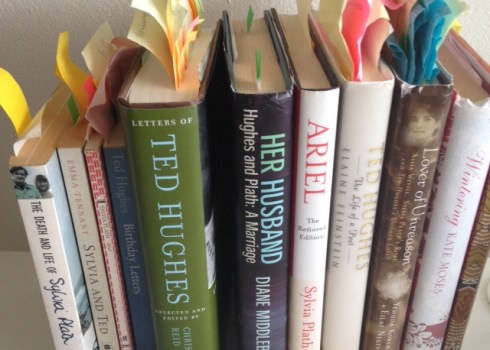
Remembering Assia Gutmann Wevill, born this day 1927 in Berlin. Tragically she took her own life in 1969. She’s the main character of my new novel, ‘Capriccio’, which retraces her stormy relationship with poet Ted Hughes. Who was Assia? Why has history treated her so unfairly? Was she, as Ted Hughes speculates in his poetry collection ‘Capriccio’ doomed to die? For answers to these questions, and more, read my novel ‘Capriccio’, excerpts of which can be found on this Blog, under the menu item ‘Excerpts’.

Read More →

The lost poems of Ted Hughes

Ted Hughes’ series of twenty poems, called ‘Capriccio,’ was first published in 1990 in a print run of only fifty. The expensively produced leather-bound volume was inaccessible to most readers, by virtue of its cost ($4000) and rare book status. It was not until after Hughes’ death in 1998, that the series was accessible in its entirety, as a brief section in ‘The Collected Poems of Ted Hughes’ edited by Paul Keegan. (Faber and Faber, 2003). Thus the full sequence of ‘Capriccio’ was virtually lost to Hughes’ readers for many years. Why did Hughes wait almost thirty years after his affair with Assia Wevill to publish these poems? Why did he tell Assia’s biographers, Eilat Negev and Yehuda Koren, that these poems were perhaps ‘not the ones I should have written’? Was this work an apologia for Hughes’ role in the life and death of Assia and Shura, intended to show destiny as the culprit? In these poems, some of which cruelly portray Assia as Lilith the devil-woman, there is little mention of Hughes’ own destructive influences. Hughes appears to argue that he’s biologically predetermined to be Assia’s prey, and that the winds of fate brought them together. The fate she carried sniffed us out, he writes in ‘Dreamers’, the only poem about Assia which is not in ‘Capriccio’. Next to Hughes’ award-winning ‘Birthday Letters’, the autobiographical nature of ‘Capriccio’ went barely noticed for many years. When the poems were […]

Read More →

Randwick Writers’ Feedback Guidelines

GIVING FEEDBACK The Sandwich Analogy: Say something positive before something negative, then finish on the positive or how to make it better. Give the positives first and say what works for you. Give the negatives next, and say what doesn’t work for you, and lastly, how you think it could be made better. Take on the task of critiquing with a positive and helpful intention; read carefully, trying to understand the writer’s point of view and creative goal. Consider the basic issues of narrative structure, characterisation, evocative and atmospheric language, vivid setting and believable dialogue.  Be honest in your feedback; the writer needs guidance, not niceties! RECEIVING FEEDBACK Be prepared to receive negative, as well as positive, feedback. Separate the personal from the product, and see feedback as a valuable opportunity to improve your writing. While receiving verbal feedback, try not to interrupt the speaker. Be ready to respond to negative feedback, after speaker has finished. Give your reasons for your opinion. Rewrite your work in accordance with the feedback received, and see if it is better. If not, stick to your guns! A sure sign that you can write is that you keep going after knockbacks.

Read More →

An excerpt from Capriccio

Shura (Alexandra Tatiana Elise) Hughes Wevill was the daughter of Ted Hughes and Assia Wevill Excerpt from ‘Pit and Stones’ a chapter in the novel in which Ted, Assia and the children are returning from a house-hunting trip in Manchester. They would never see each other again. Just then the train gave a great jolt. Frieda, who’d been leaning forward, was catapulted into Assia’s lap. Ted braced himself and held on to Nick’s shirt tail. A squeal of brakes followed, and the train groaned to a shuddering stop. From somewhere in another compartment they heard a woman’s scream. Shura began to cry, still clutching the half-eaten cake. Assia held her close with one arm while protecting Frieda with her other. ‘What’s happening?’ she asked the world in general, and Ted in particular. ‘You stay here with the children. I’ll try to find out. And for God’s sake, can’t you stop your daughter snivelling?’ Assia turned her face away, smoothing Shura’s hair tenderly. ‘It’s all right, liebchen. Soon we’ll all be home.’ To Ted she said coldly, ‘You seem to forget that our daughter has just turned four. Just like you ‘forgot’ to come to her birthday party. This trip’s a great deal harder for her than it is for Frieda and Nick.’ © Dina Davis

Read More →

Thoughts on Capriccio

EXCERPT from my Article: ‘On Ted Hughes’ Capriccio’ Hughes’ collection of twenty poems, Capriccio, was produced in 1990 as a beautiful boxed volume with leather covers. Printed on hand-made paper, and at $4000 a copy, the book was designed to be rare.[1] Each of the fifty volumes was signed by the author, and also by the illustrator, Leonard Baskin, whose company […]

Read More →

Au Revoir Darwin

Au Revoir Darwin 2013 Three more days. I want to embrace this place, to squeeze the last moments of joy from this my second home. Today we’ll visit the markets, for the jostle of colours, the smells of sizzling spicy food and the taste of my favourite mango lime juice, its stringent iciness going straight to my brain. Then to […]

Read More →

Who was Assia Gutmann Wevill?

    Lucas Myers, a lifelong friend of Ted Hughes, writes: ‘Sylvia’s rival had been misrepresented. She was a touch too elegant for her own well-being, fundamentally very vulnerable, needed a lot of affection, and could remembe SS boots outside the railway carriage compartment as her family, half Jewish, approached the Swiss border.’ – Lucas Myers, ‘Ah, Youth … Ted Hughes and Sylvia Plath at Cambridge and After’ (from ‘Bitter Fame’ by Anne Stevens, Appendix 1). Peter Porter writes  of “the cruelty of excising Assia’s true part in the Hughes/Plath heritage, assigning her only the role of marginal temptress, whom we all seem to have allowed to be airbrushed out of literary history.” Porter, an eminent Australian poet,  knew Assia well. He writes of her: “She had wit, charm and generosity, and while she could be wilful and self-dramatising, she was also natural and straightforward. [Assia] grew up speaking German, Hebrew and English. She attended an academy for well-off Arab children who identified with the Mandated British. Somehow she acquired a beautifully modulated English voice long before she set foot in Britain.” While answering an advertisement for a London flat placed by Hughes and Plath in a newspaper, the fourth and fatal attraction of her life began. My novel ‘Capriccio’ traces the vicissitudes, joys, and agonies of the love affair between Assia and Ted Hughes. Excerpts from Peter Porter’s Review of ‘Lover of Unreason’ in The Guardian, Saturday,  28 October 2006

Read More →
Navigating this Blog

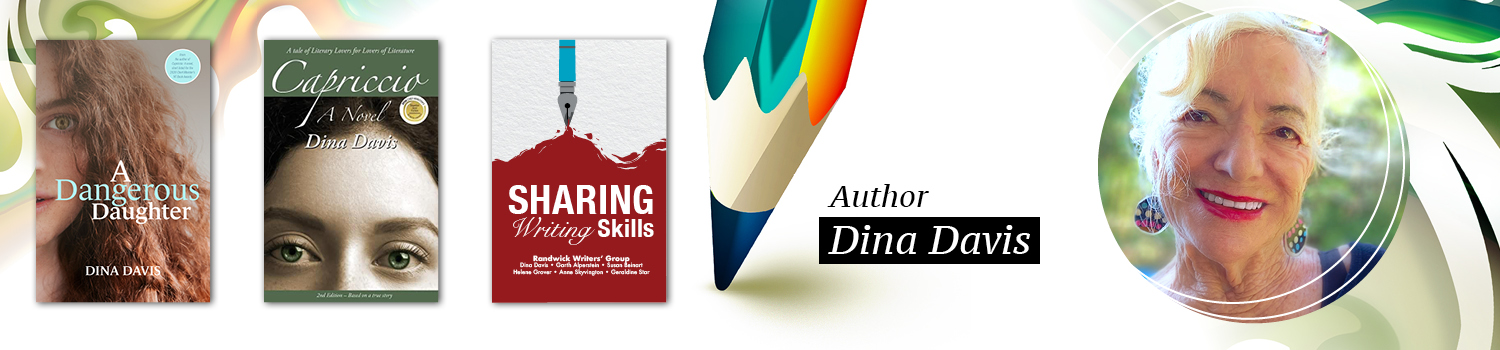
WELCOME TO MY BLOG, A FORUM FOR READERS AND WRITERS Please feel free to navigate at your leisure, and I hope pleasure, throughout this Blog. This is how: If you want to know more about me, click on ‘ABOUT ME’ on the horizontal Menu Bar. To see my latest posts, click on POSTS on the menu bar, and scroll down, ad infinitum (there are older blogs there if you keep scrolling). To read bits of my my upcoming  novel ‘Capriccio‘, click on EXCERPTS on the menu bar. ‘ Capriccio’ can mean ‘whimsical’ (at the whim of fate) and ‘horror’ ( literally ‘hair standing on end’ in ‘Old Italian.) Both Fate and Horror are major themes in my novel, which is a work of fiction based closely on fact.  My title comes from a series of 20 poems by Ted Hughes, published in 1990 in a limited print run. They deal with his relationship with Assia Wevill, the woman for whom he left Sylvia Plath.  Watch this space for excerpts!  I am also convenor of the Randwick Writers’ Group, a locally based forum, limited to five members, who meet fortnightly in each others’ homes. The feedback we give each other is meticulous and constructive, and has been invaluable to me in completing my manuscript.   DISCLAIMER:  All posts, including photographs, artwork, and writings, on this site, are protected by copyright.© DIna Davis 2015

Read More →

Darwin in the Wet

DARWIN, NT, FEBRUARY 2014 Here in February the air is heavy with moisture, sweat, and an all-encompassing blanket of sticky heat. There’s that special Darwin smell, a mixture of wet earth, tropical air, and the ubiquitous spices of lemongrass, curry leaves, cumin and chile. We could be somewhere in south-east Asia. “Fecund” is the word to describe Darwin in the Wet. […]

Read More →

Darwin in the Dry

DARWIN, JULY, 2013. Clear blue skies, balmy days, cool nights. Temperature in Darwin today 29deg top, 16 low. Cool for Darwin. Locals are shivering. Out come the doonas,  bed socks,flannelette sheets. It’s not  uncommon to see hoodies and fleecies being worn, when the temperature is in the low thirties. In the dry, the breeze off the Arafura Sea is cool and refreshing. Gone is the stillness, stickiness, and heaviness of the humid build-up. The rains of the Wet have dried up, leaving almost empty water-holes and a sky so blue and clear it’s like a child’s painting.   Another name for the Dry is the ironically named Mother-In-Law Season. Granny flats are suddenly occupied by families who’ve driven or flown the 4000 kms to be with their loved ones. Grey nomads in their vans and motorhomes invade the caravan parks, and NSW, Victoria, and Queensland number plates fill the streets. The letters page of the NT News abounds with snide suggestions such as ‘Southerners Go Home’ while the front page inevitably bears an image of the latest crocodile scare. We from Down South are greeted in a friendly fashion with ‘Must be the Dry; you’re here again.’ I hasten to defend myself, assuring Darwinites that I’ve been here in  the Wet, the Build-up, and the Knock-Em Down seasons, as well as the Dry. Admittedly it’s supremely satisfying to be revelling in warm sunny days while those at home are freezing. […]

Read More →