How to Critique – Combing Prose

To Show or to Tell? When is Telling OK? This is a perennial topic for working writers. Vera Aisling, I’m her post ‘Combing Prose,’ has some interesting thoughts on this, and other aspects of critiqueing.
To Show or to Tell? When is Telling OK? This is a perennial topic for working writers. Vera Aisling, I’m her post ‘Combing Prose,’ has some interesting thoughts on this, and other aspects of critiqueing.

Joan Didion, renowned author of ‘Blue Nights’, ‘Slouching towards Bethlehem’ ‘the Year of Magical Thinking, and other works of both fiction and non-fiction, has this to say about the writing process. The author of fifteen books, Didion has developed her own writerly habits. She described her work as cycling between new writing and revision: “Before I start to write, […]
I’ve recently been reading novels by the wonderful Australian writer, Joan London. ‘The Golden Age’ and ‘Gilgamesh’. Both are wonderfully written, award-winning books, yet they seem to break many of the ‘rules’ we aspiring writers are taught in the many popular courses in the craft of writing. Professor Elizabeth Webby writes: ‘Unlike much contemporary Australian fiction, Joan London’s novel ‘Gilgamesh’ is not narrated in the first person or from the perspective of one character. This makes the author’s task more complicated but results in a much richer reading experience since we are allowed into each character’s inner life, making them all vividly present.’ Yet London ignores many popular precepts, and with powerful results. For example, in her novel ‘Gilgamesh’, about an innocent country girl who goes on quest to find the father of her child, the Point of View (POV in writer-speak) often changes from one character to the next even on the same page. Yet I found her writing compelling and beautiful. Here, for instance, is a short excerpt from ‘Gilgamesh’: ‘They had met in Iraq, where Leopold was working on an archaeological dig not far from Baghdad, on the Euphrates. Aram was working on the expedition as a driver. He was Armenian, born in Turkey, where his parents had died when he was very young.’ Thus London introduces two of her main characters. But is this ‘showing’ or ‘telling’? Telling’ is a travesty of good writing practice, […]
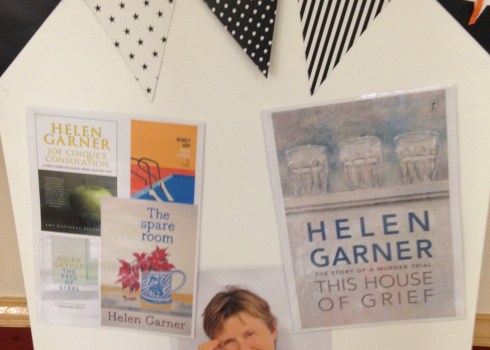
“The most compelling thing I’ve read online recently is Helen Garner’s piece in The Monthly, ‘The insults of age’. Garner’s writing is always emotionally intelligent and always delivered with a clear-eyed grace, but this piece – her perspective on what it means to be a 71-year-old woman – is a particular gem. The cultural assumption that the ageing are almost-dead […]
Janet Malcolm, in her masterly work on the biographies of Plath, makes an interesting point about fiction having more ‘truth’ than non-fiction. It’s fascinating to consider that in some respects fiction could be more true than nonfiction. Fiction is part of a closed world, all in the author’s mind, and even if the author deliberately leaves options open, that openness is part of the author’s created world. With nonfiction, there really is a truth that happened, but there are so many mediators between that truth and the reading audience, each interpreting the facts differently or choosing which facts to reveal, with some having a stake in how the story is presented and understood. How can one be sure of the truth? What’s Fact, what’s Fiction? In ‘Capriccio’ I use the facts of Assia’s life as a scaffolding on which to build the deeper truth of emotions, thoughts and conversations, using fiction. For example, in my chapter entitled ‘Edge’, we know the facts are that Sylvia wrote a letter, and asked for stamps, on the night she took her life. The letter, if it was found, has never been disclosed. My excerpt from that letter is invented, an imagined version of what she might have written on that last day. The fictional letter from Sylvia contains the things Assia might have read about herself. We also know that Assia was shocked to read the vituperative language Sylvia wrote about Assia and David in the […]
HOLDEN Caulfield, the teenage protagonist of J. D. Salinger’s The Catcher in the Rye, says: “What really knocks me out is a book that, when you’re all done reading it, you wish the author that wrote it was a terrific friend of yours and you could call him (sic) up on the phone whenever you felt like it.” That’s how […]

Thoughts on Helen Garner’s latest book I’ve just finished reading ‘This House of Grief’, Garner’s latest non-fiction work. It was almost too painful to read at times, not only because of its ghastly subject matter, but also due to Helen’s signature style: holding nothing back, inviting the reader to share with her the horror of seeing a man accused, wrongly […]
 Go to my contact page to get in touch about my writing and the writing process.
 dinadavisauthor
 Dina Davis Author